
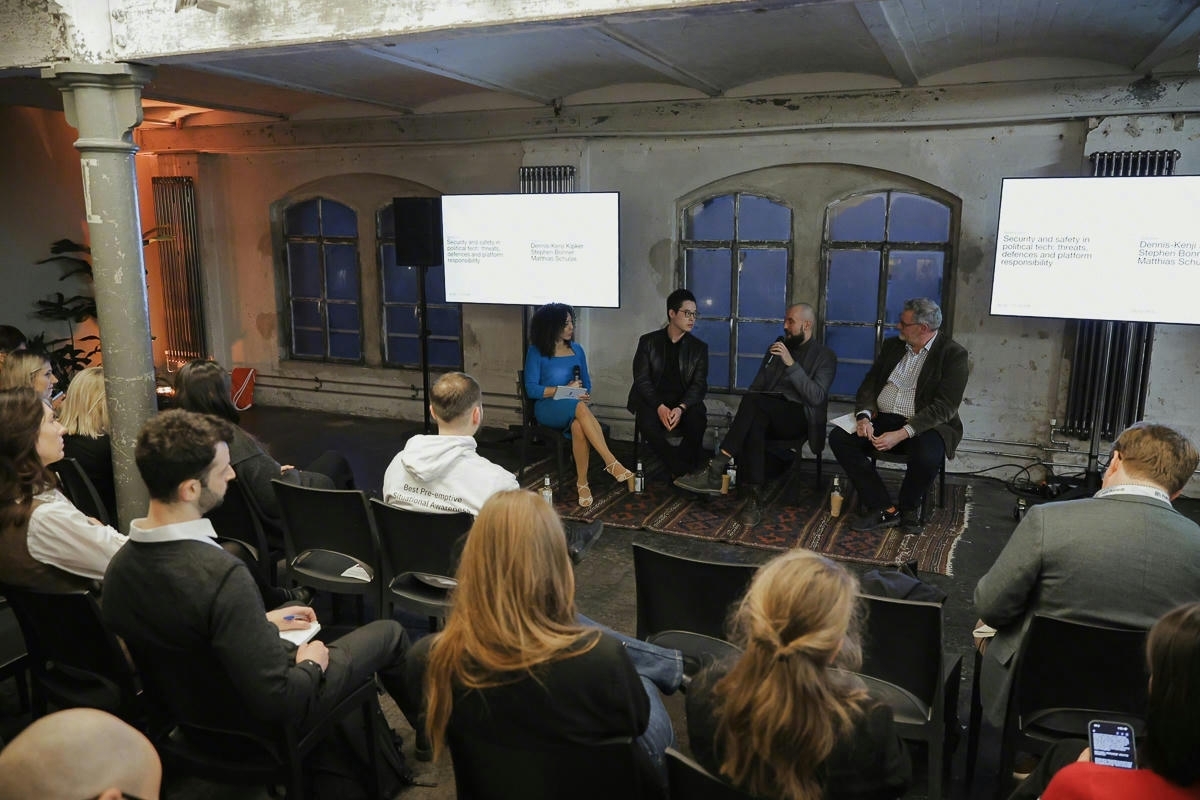
ICS particiapted at the Political Tech Summit on “Security and Safety in Political Tech – Threats, Defences and Platform Responsibility”, held in Berlin on January 23, 2026.
The session brought together experts from TikTok, civil-society and researchers to discuss how platforms can not only keep users safe but also demonstrate their commitment to security, integrity, and transparency.
Matthias’s contribution focused on how cyber threats have evolved into geopolitical weapons, highlighting two dimensions shaping today’s threat landscape:
– Classical cyber operations such as ransomware, espionage, and hacktivism, increasingly used by state and non-state actors from Russia, China, Iran, and North Korea to pursue political, economic, or military goals.
– The convergence of cyber and influence operations, or “cognitive warfare,” where technical infrastructure and psychological manipulation merge to erode trust, fuel polarization, and destabilize democracies.
Matthias argued that algorithmically manipulated social media feeds, optimized for engagement rather than truth, now pose an existential threat to democratic processes—especially as they shape political opinion, emotional states, and social trust. With nearly 40% of citizens using social media as their sole source of political information, this issue goes far beyond election security.
The recommendations focused on a three-layered response:
- Platform accountability – greater transparency, stronger API authentication to prevent Bots, labeling of AI-generated content, and algorithms that prioritize truth and quality instead of outrage.
- Government action – enforce digital education from early school onwards, establish interoperable data standards to track cross-platform disinformation, and hold platforms liable for harmful political content.
- Individual resilience – digital literacy, mindful consumption, and limiting daily social media and smartphone use to rebuild trust and cognitive health.
Democracies need courage — and fast, concrete action. Pilot projects restricting social media access for minors, as tested in other countries, could be a step forward toward a healthier digital environment. We should scientifically test such proposals on a small scale, say in one Bundesland, for a limited amount of time and evaluate the results. Action instead of endless discussions!
The discussion reaffirmed that protecting democratic processes in the digital age requires collaboration between tech, government, researchers, and citizens alike.
Read more about the event here: Political Tech Summit – Security and Safety in Political Tech