
Research Topics

Cyber Conflict
Cyber conflict & the use of offensive cyber operations or active cyber defence as an element of International Relations. Governance of the cyber domain: cyber norms, confidence building measures and international law.

Cyber-Security & Strategies
Cybersecurity & cyber defence best-practices: vulnerability disclosure, cyber ranges, bug bounties and the evolution of security controls. Peace and security implications of the cybercrime ecosystem & ransomware. Analysing cyber strategies of allies and adversaries.

Hybrid Threats & Information Warfare
Information warfare, cognitive threats, memetic warfare and the use of synthetic media to influence democracies.
Publications
-
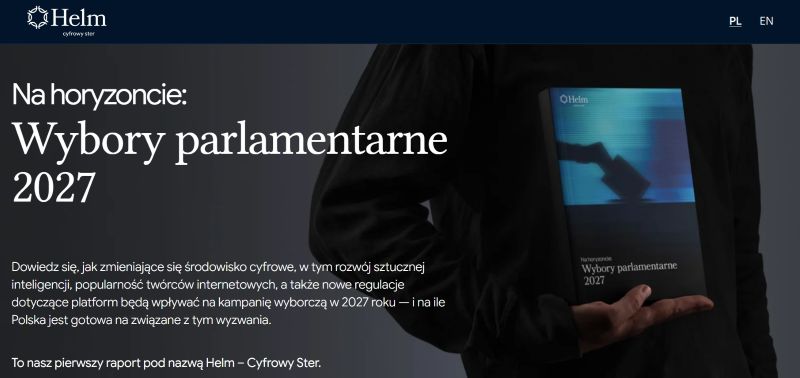
Mateusz is a co-author of a report published by the HELM Foundation on the potential impact of artificial intelligence on democratic elections. In the report, Mateusz described how large language models can be manipulated – both through the use of GEO methods and LLM grooming, as well as through direct instructions issued by the model…
-
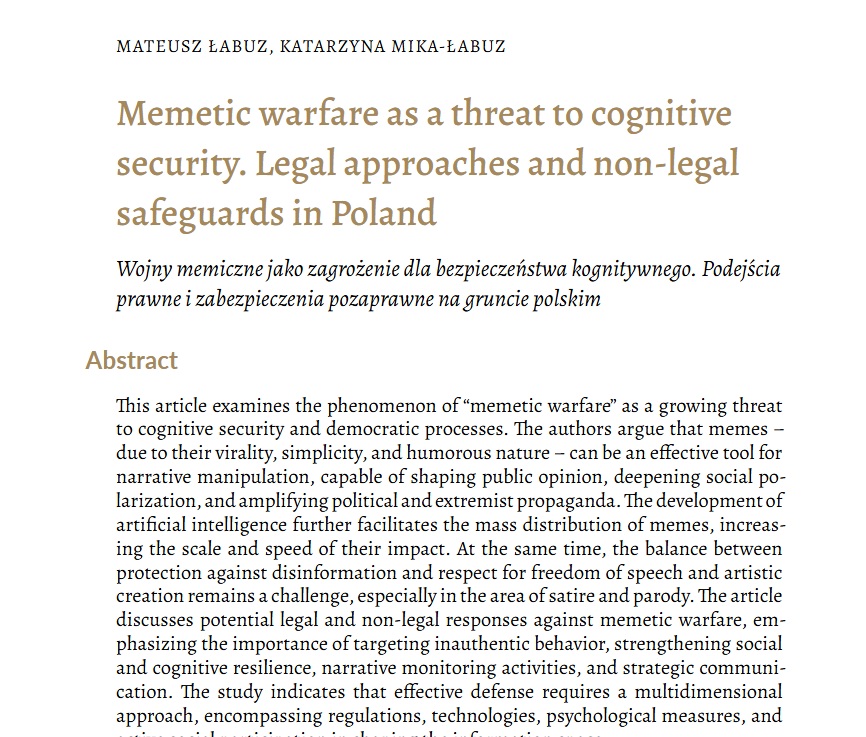
Mateusz and Dr. Katarzyna Mika-Łabuz published peer-reviewed article titled “Memetic warfare as a threat to cognitive security. Legal approaches and non-legal safeguards in Poland” in Prawo i Więź (No. 4/2026). Would you see memes as a weapon? Well, you better do so! Memes spread extremely fast, carry emotion, and are hard to regulate without hitting…
-

Antonia Bulfon and Lena-Sophie Drews published a policy paper at European Governance Lab. It is about how discussions of European digital dependencies often focus on U.S. software, but China’s role in European network infrastructure deserves equal attention. This paper analyzes why the EU has struggled to regulate the risks posed by Huawei and ZTE. Beyond…
-

Europe is investing billions in digital sovereignty (its own clouds, chip manufacturing, AI models), yet foreign providers still dominate. Around €264 billion flows to non-European cloud and software providers every year, so Europe is effectively financing its own dependence. The main bottleneck is demand rather than investment: as long as public bodies and companies choose…
-
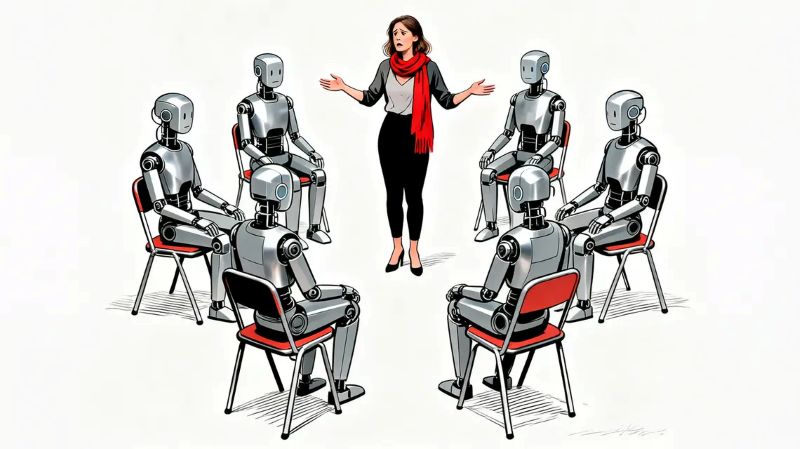
Mateusz, Dr. Paweł Szczęsny, and Dr. Katarzyna Mika-Łabuz published peer-reviewed article titled “Large language models (LLMs) as psychotherapists: an analysis based on psychodynamic psychotherapy theory” in Ethics and Information Technology (Vol. 28). And it has a huge cybersecurity element! Emotional support is one of the most common uses of generative AI. The authors test whether…
-
Mateusz wrote the peer-reviewed book chapter titled “Toward Transparency of Synthetic Media: EU Regulatory Perspective and Its Implications” published in the Handbook of AI-based Media Disruption (Springer), edited by Stephan Böhm, Stephen Collins, Alexander Godulla, Sarah Keith and Richard Savery. The chapter analyses the AI Act’s transparency obligations for deepfakes and AI-generated content. These provisions…
-

Mateusz has just published the German edition of his book and it is titled “Das Ende der Wirklichkeit. Deepfakes, synthetische Welten und der Beginn der Post-Realität”. The book was published by Rheinwerk Verlag. The foreword was written by Prof. Dr Beate Neuss. The book starts from a simple question: what happens when artificial intelligence no…
-
Together with Maria Pawelec (IZEW, University of Tübingen), Mateusz published another peer-reviewed article titled “Are Softfakes Really ‘Soft’? Semantic, Ethical, and Legal Perspectives on Deepfakes and AI-generated Visualizations in Political Campaigning” in the International Journal of Politics, Culture, and Society. Though one might not be familiar with that, “softfakes” is a label for deepfakes and…
-
Mateusz co-authored peer-reviewed article titled “Gender and identity disinformation: impacts on female politicians, and implications for democratic participation – roundtable discussion”, published in the Journal of Gender Studies. The text records a roundtable discussion hosted by the Artemis Alliance in March 2025, with Kate Saner, Kim Barker, Marilia Gehrke, Martha Stolze, Louise Hooper and Maria…
-
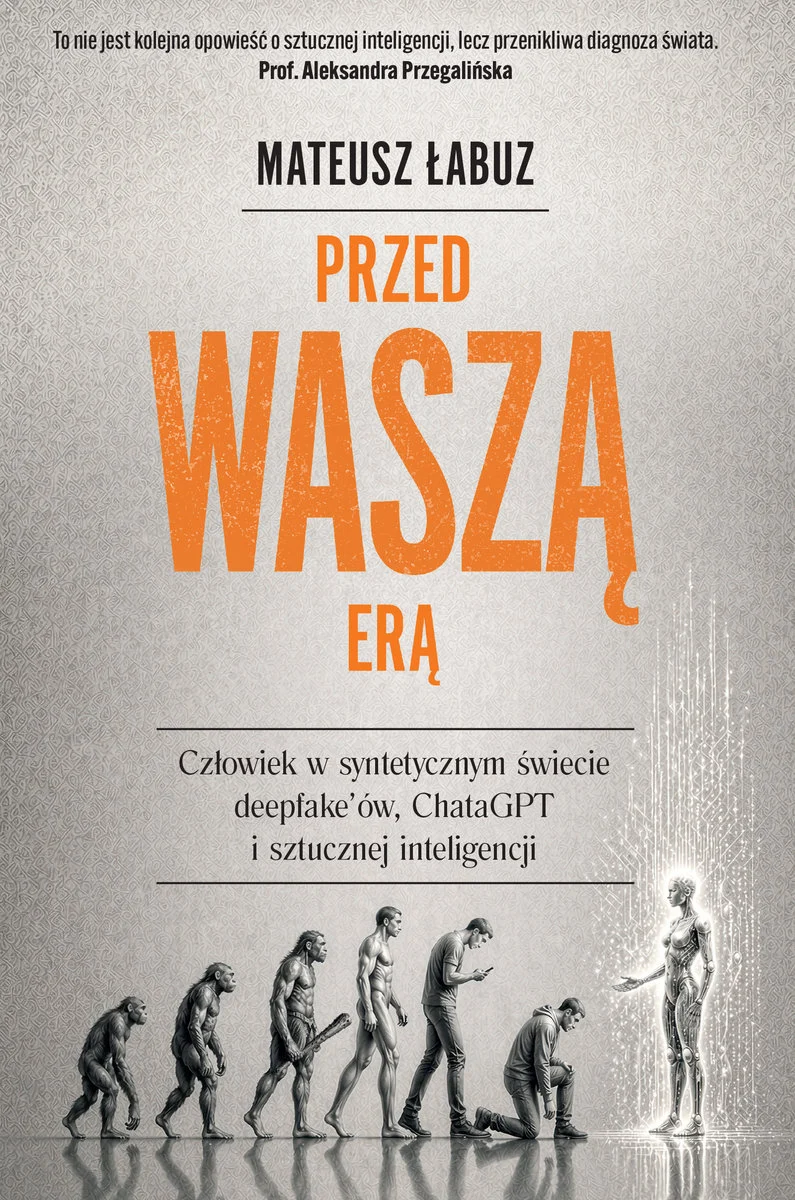
Mateusz has just published his book titled “Przed Waszą Erą. Człowiek w syntetycznym świecie deepfake’ów, ChataGPT i sztucznej inteligencji” (Wydawnictwo Filia, currently available in Polish language). The German edition of the book would be published in September under the title “The End of Reality. Humans in the Age of Deepfakes, ChatGPT, and Artificial Intelligence”. The…
Archive
- Report on how AI can influence democratic elections published
- Memes as weapons: memetic warfare and cognitive security in Poland
- New Policy Paper: Wired to Beijing? Huawei and ZTE in European Networks
- Lena Drews published a IFSH Brief Analysis: “Europe Is Financing Its Own Digital Dependence”
- Can a chatbot be your therapist? New article in Ethics and Information Technology
- Labelling synthetic media: Mateusz’s chapter in the Springer Handbook of AI-based Media Disruption
- Seeing is no longer believing: Mateusz’s book “Das Ende der Wirklichkeit” premieres in Germany
- Are “softfakes” really soft? New open-access article on AI in election campaigns
- Gendered disinformation against women in politics: roundtable in the Journal of Gender Studies
- Mateusz published the book “Przed Waszą Erą”
- Lena and Mateusz published an article in the newspaper “Praxis der Wirtschaftsinformatik”
- Mateusz co-authored book
- Peer-reviewed article on deepfakes
- OpEd on deepfakes and election campaigns in Disruptor Tech Media
- Article on the need to upgrade German active cyber defense, published by the Internationale Politik
- Peer-reviewed article on regulating deepfakes in the AI Act
- Policy commentary on synthetic media and its influence on political advertising
- Peer-reviewed paper on Cyber Operations in the Wars in Ukraine and the Gaza Strip published
- Article on Cyber- and Information-Wars in “Auftrag”
- OpEd on US tech-authoritarianism and EU dependencies by Heise.de
- OpEd on synthetic media abuse in hAI Magazine
- OpEd on NCII published by EUObserver
- Peer-reviewed article published in “Politics & Policy”
- Policy report on NCII published!
- Addressing Child Sexual Abuse Materials in peer-reviewed article
- OpEd on tech-authoritarianism published in Golem.de
- OpEd for Tagesspiegel Background on LLM-Grooming
- Policy report on deepfakes and sexual abuse
- OpEd for Tagesspiegel Background on “memetic warfare”
- Policy Report “The Pervasive Influence of AI on Global Political Campaigns 2024”
- Peer-reviewed article on defining deepfakes in the AI Act