
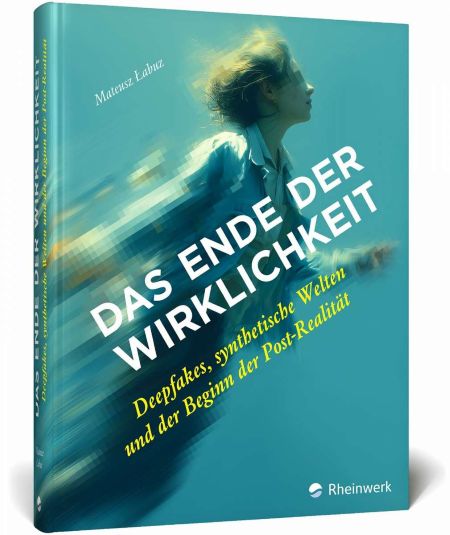
Mateusz has just published the German edition of his book and it is titled “Das Ende der Wirklichkeit. Deepfakes, synthetische Welten und der Beginn der Post-Realität”. The book was published by Rheinwerk Verlag. The foreword was written by Prof. Dr Beate Neuss.
The book starts from a simple question: what happens when artificial intelligence no longer only produces texts, images and voices, but also simulates emotions, relationships and memories? Across more than five hundred pages, Mateusz asks what we can still believe, whom we can trust and how generative AI changes work, values and how we perceive reality. The publisher sums it up with the fitting line “Sehen heißt nicht mehr glauben” – seeing is no longer believing.
As with the Polish edition, the focus is on people rather than technology. Each chapter looks at one dimension of what we call “synthetic”:
• Synthetic data – a new raw material and an old form of colonialism
• Synthetic language – the hunt for bots and AI-powered cheating
• Synthetic values – what algorithms “believe in”
• Synthetic fraud – voice clones, scams and deepfakes
• Synthetic waste – how the internet fills up with AI slop
• Synthetic characters – falling in love with someone who does not exist
• Synthetic death – digital avatars of the deceased and the future of mourning
• Synthetic reality and synthetic future – who owns reality, and how to keep the human in the loop?
And the English version is coming pretty soon, as it would be published by CRC Press in December this year under the title “The End of Reality: Humans in the Age of ChatGPT, Deepfakes and Artificial Intelligence”!